How to play
A quick simultaneous game for two sketchy schemers, by Jonathan Leistiko. Rules and the paper play sheet: invisible-city.com/content/write-and-roll-–-powers-‘n-points-war-pnp.
Most roll-and-writes have you roll, then write. This one is the other way round: you write first, betting on what the dice will do, then roll and see.
Your sheet
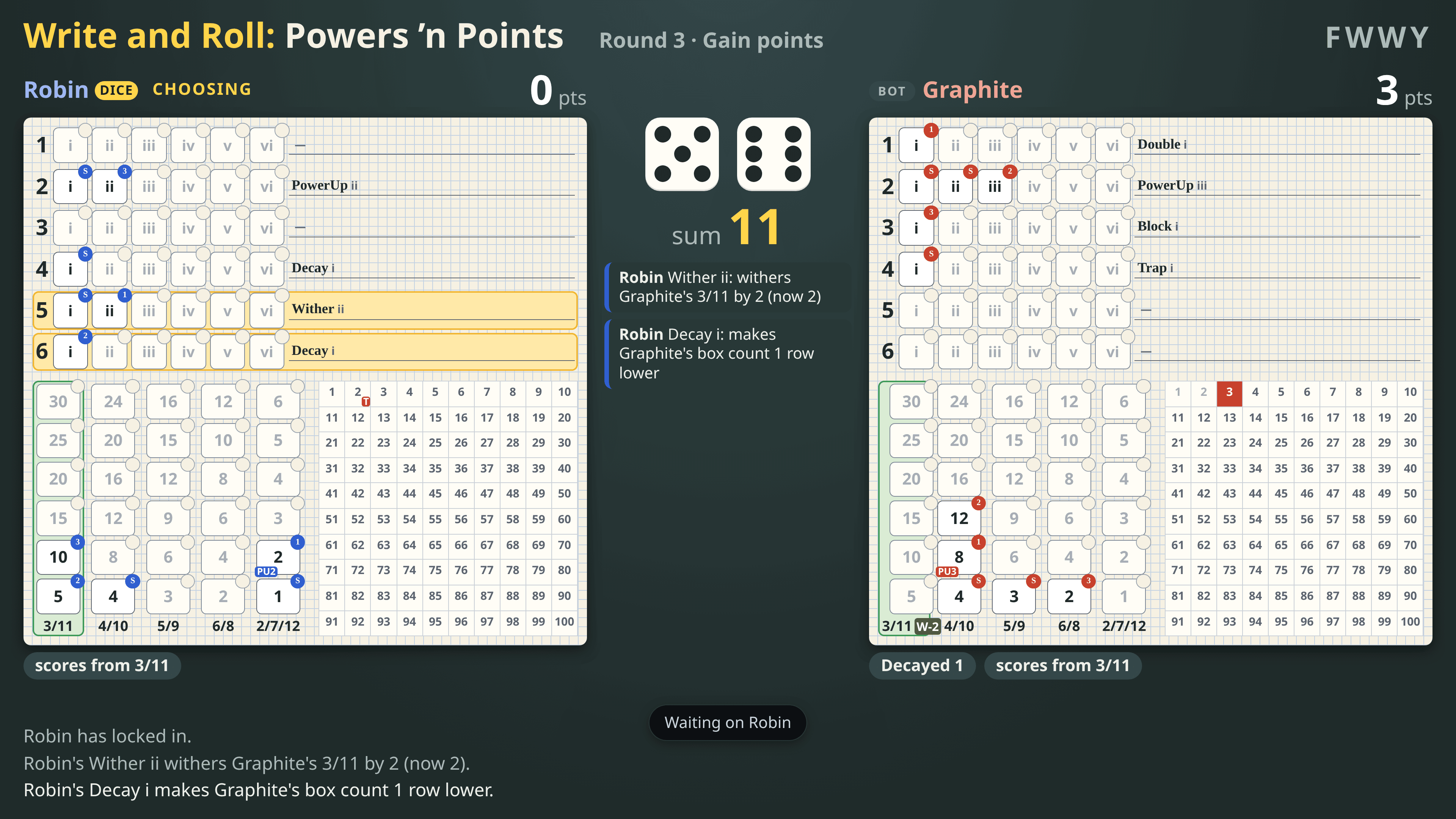
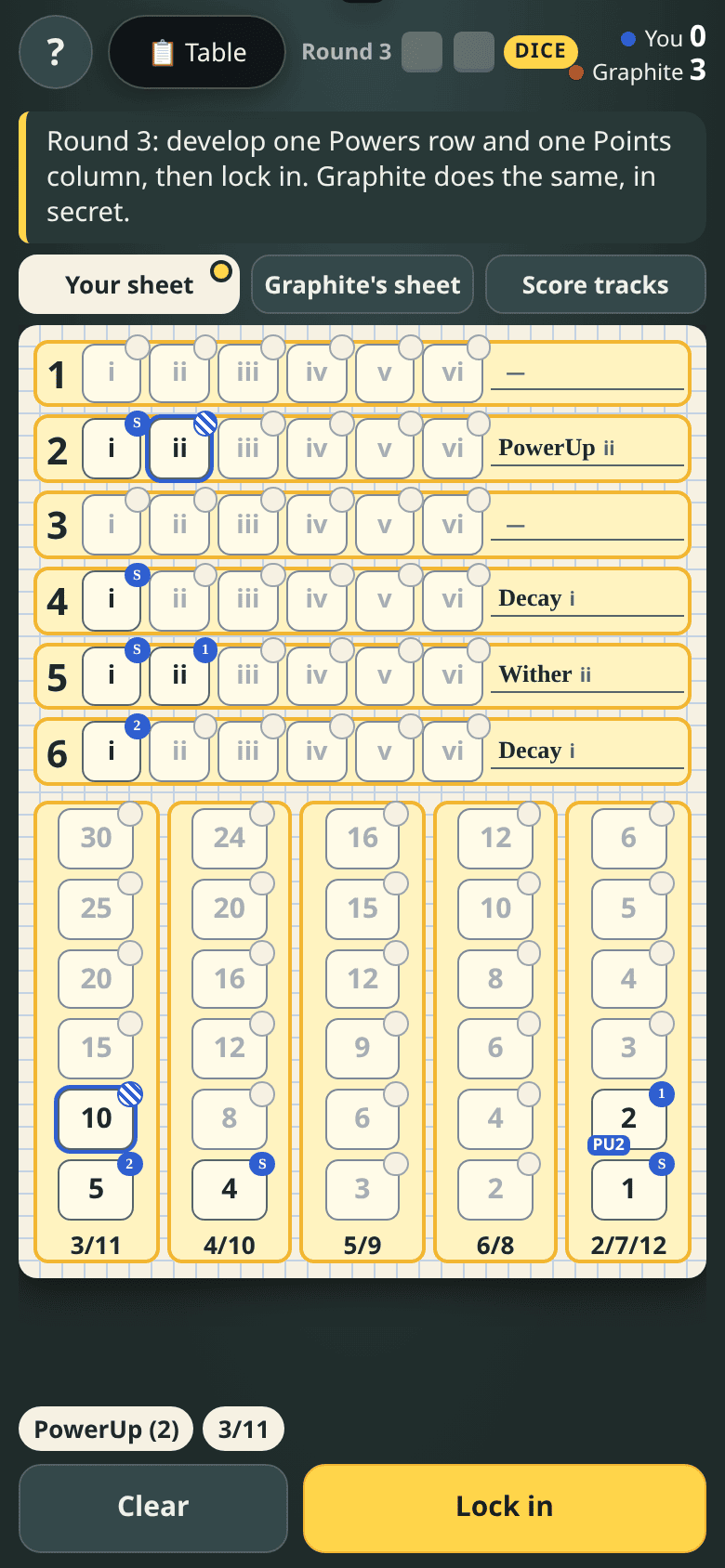
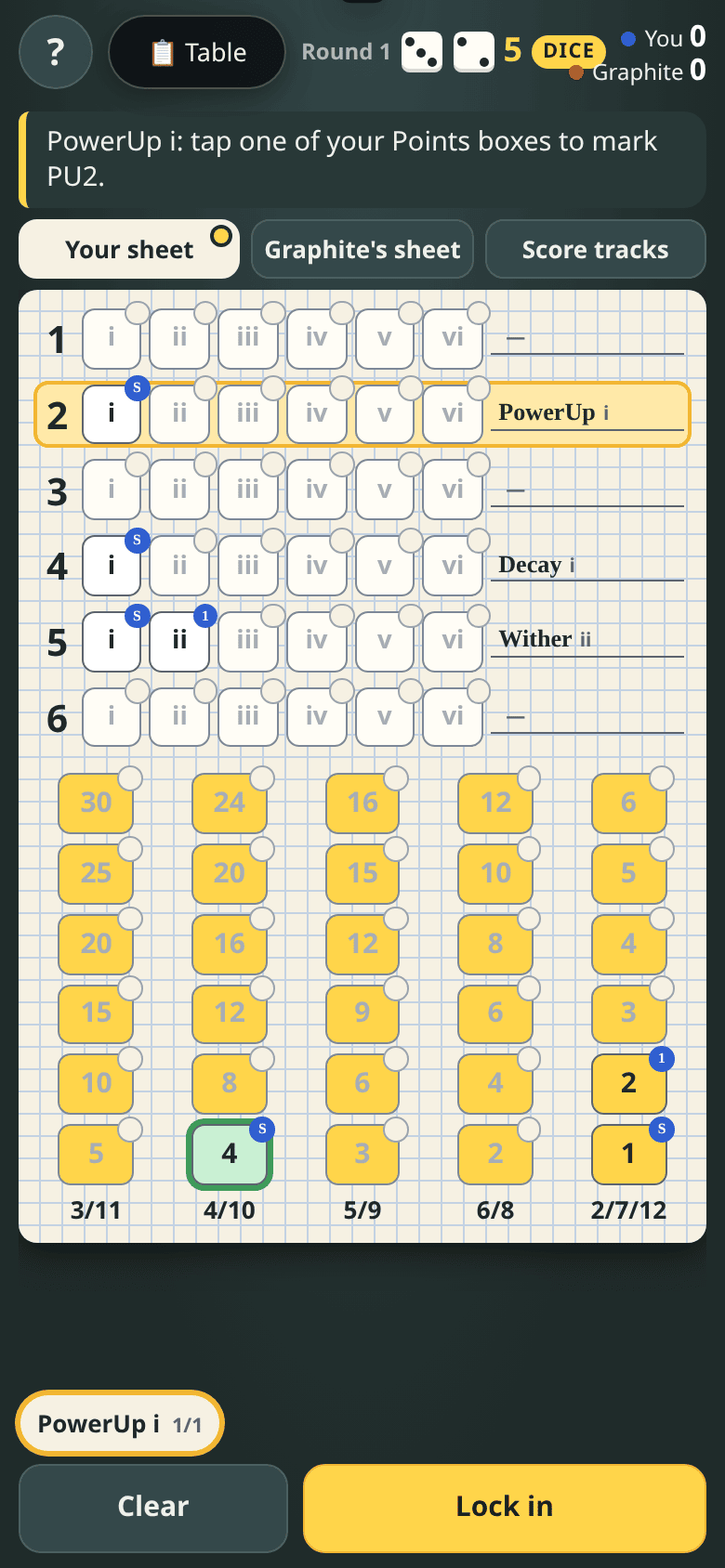
- Powers: 6 rows numbered 1 to 6, each with 6 boxes, i to vi. Developing a row fills its next box, left to right. The first time you develop a row you choose its power, for the rest of the game. The highest box filled is the power's level.
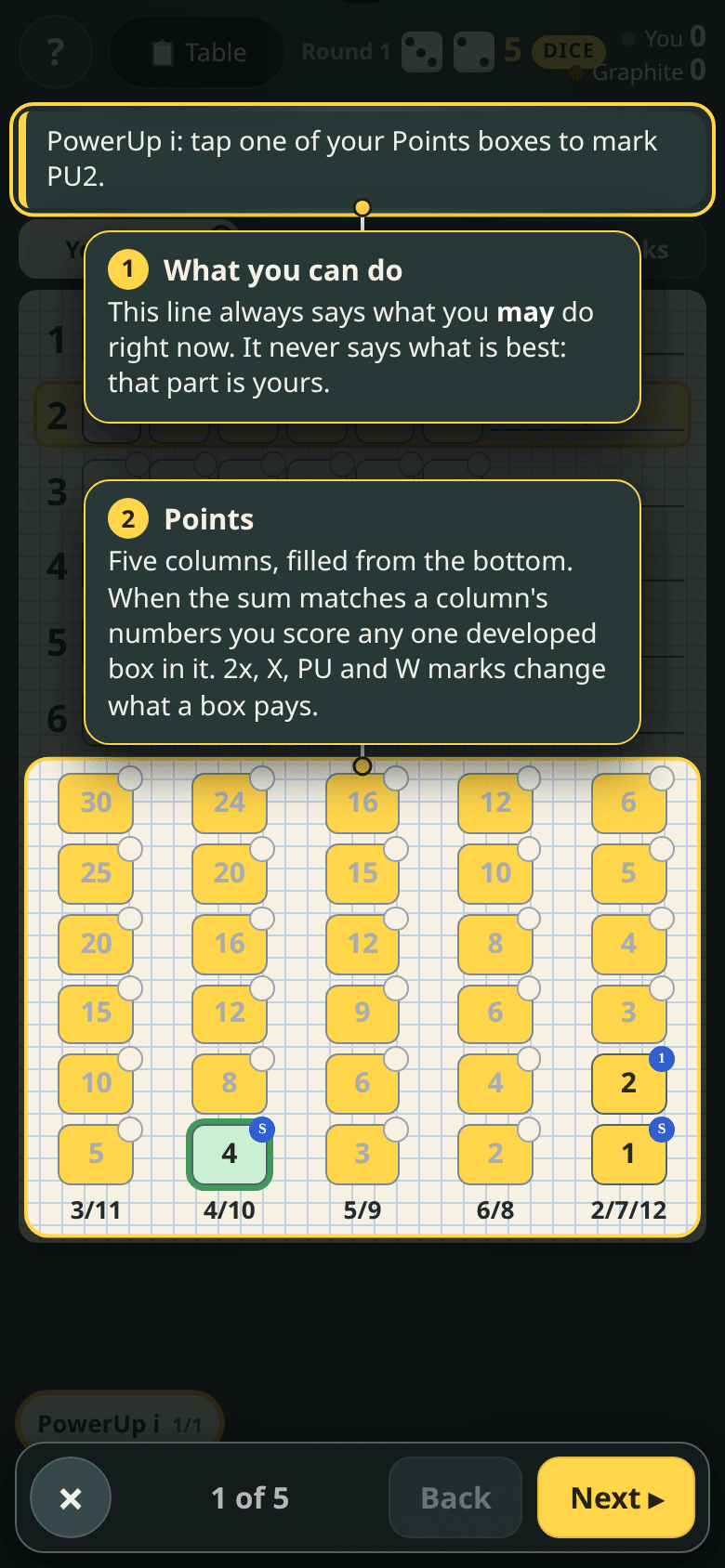
- Points: 5 columns, 3/11, 4/10, 5/9, 6/8 and 2/7/12, each filled from the bottom. The common sums pay little per box; the rare ones pay a lot.
- Score track: 1 to 100. Your opponent may set traps on it.
- Both sheets are open, as on a real table: you can look at the other one any time. What is secret is a choice that has not been revealed yet.
A round
- Start: both develop 5 boxes, Powers or Points in any mix. A coin toss picks who holds the dice first.
- Develop: both secretly develop one Powers box and one Points box, then lock in. Both are revealed together.
- Roll: the dice holder rolls two dice.
- Powers: each die fires the Powers row with its number, on both sheets. Doubles fire it twice. If a power asks for a target, you choose it in secret; then everything happens at once. A power is as strong as it was when the dice landed.
- Gain points: the sum picks your Points column. Score any one developed box in it (it does not have to be the highest).
- End: if someone has 100 or more and the top score is not tied, the higher score wins. Otherwise the dice pass and a new round starts.
The powers
| Power | Boxes i to vi | What it does |
|---|---|---|
| Grow | +1 / +2, them +1 / +2 / +3, them +2 / +3, them +1 / +3 | Extra developments now. Some levels give your opponent some too; they choose where. |
| Double | 1 to 6 boxes | Mark your Points boxes 2x. The next time you score one, it pays double and the mark is erased. |
| Bend | ±1 to ±6 | Move the sum up or down for your Points only. It does not change which powers fire. |
| Block | 1 to 6 boxes | Mark the other player's Points boxes X. Scoring one pays nothing and erases the X. |
| Steal | row 1 to 6 | Take points from them: up to that row's number in your column this round, and no more than you scored. |
| Cancel | i to vi, 1 to 6 | Stop one of their powers of the same level or lower, or erase that many marks (2x, X, PU, T) from either sheet, or take that much off one Wither. |
| Trap | 1 to 6 numbers | Mark numbers on their score track. If their score lands exactly on one, you erase one of their developed boxes. |
| Decay | 1 to 6 rows | This round, the box they score counts that many rows lower (no lower than nothing). |
| PowerUp | x2 to x7 | Mark one of your Points boxes PU. The next time you score it, multiply. |
| Wither | 1 to 6 | One of their Points columns pays that much less per score, for the rest of the game (never below 0). Withers add up. |
A box holds one mark at a time. Wither comes off before a multiplier: a 20 with Wither 9 and PU3 pays (20 − 9) × 3 = 33.
Good to know
- You can change a choice until the other player locks in too. Then both are revealed.
- Your phone only lets you tap what the rules allow, and it does the sums: scores, marks, traps, who goes next.
- When two powers clash (two Cancels aimed at each other, two marks for the same box), the dice holder's goes first.
- Hard Decisions (a lobby choice): the game also ends after round 20, highest score winning. Ties still play on.
- Bots play by the same rules through the same door: they see what a player sees, never a locked-in choice.
- If your phone sleeps, your seat waits. A bot covers for you only after five minutes, with a clock on screen first, and one tap takes the seat back.